
The Future of AI in Logistics and Supply Chains
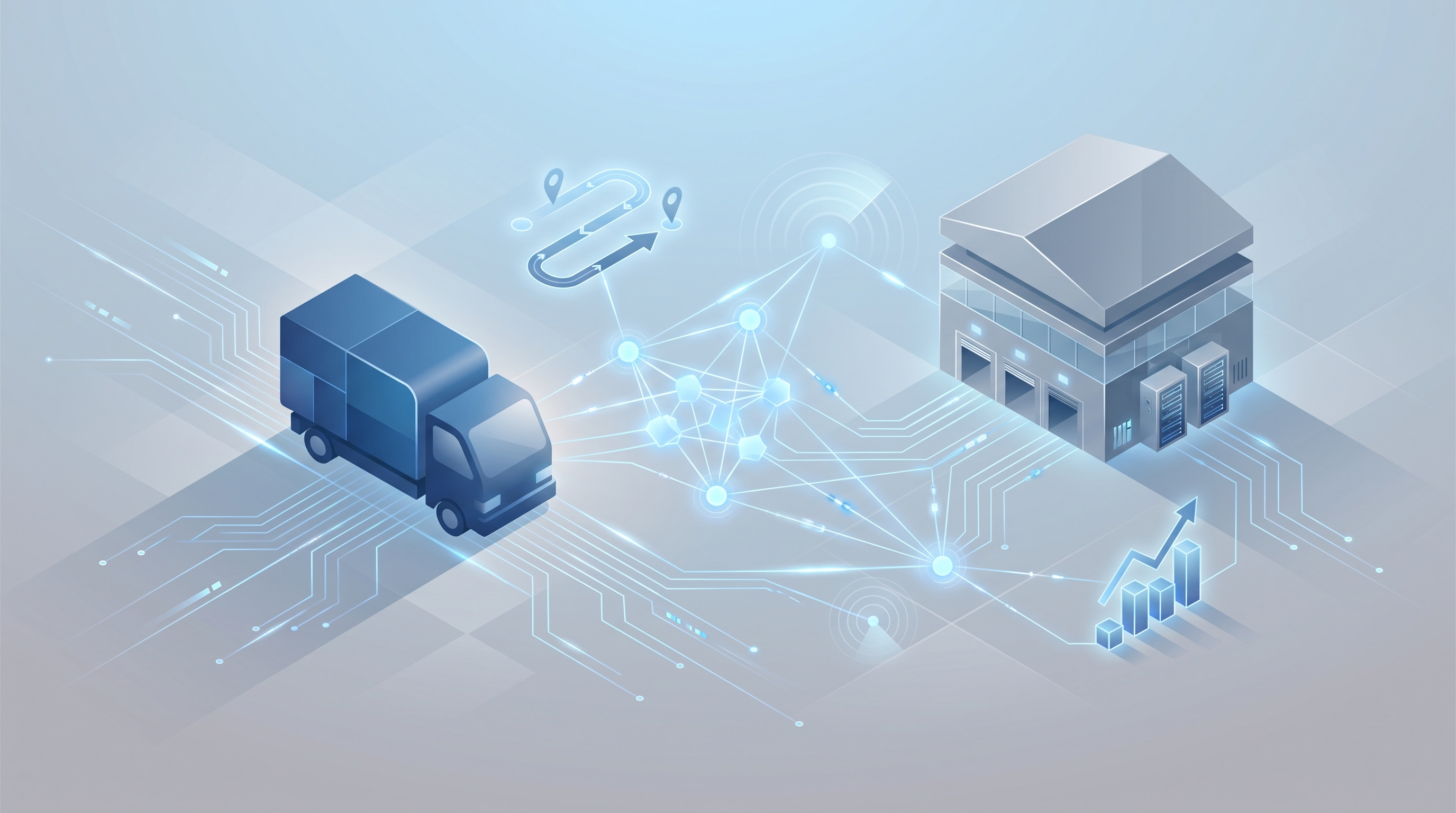
AI is no longer a side project in logistics — it already touches forecasting, route planning, and exception management at companies around the world. This guide breaks down where AI in logistics stands today, what it can realistically do for a supply chain team, and where the technology is headed next.
What "AI in Logistics" Actually Means
"AI in logistics" covers a wide range of tools, not one single feature. It includes machine learning models that predict demand, algorithms that sequence delivery stops, and systems that flag a shipment before it goes late.
Some of these tools have been in production for years, quietly running behind dashboards. Others — like a conversational assistant that answers questions about your fleet in plain language — are newer and still maturing across the industry.
The common thread is data. AI in logistics works by taking the operational data a company already generates — orders, locations, transit times, inventory counts — and turning it into a prediction, a recommendation, or an automated action.
Where AI Is Already Changing Supply Chains
Three areas show the clearest, most-adopted AI use in logistics today:
- Demand forecasting. Machine learning models study historical order patterns, seasonality, and outside signals to predict what a warehouse will need to stock next.
- Route and load planning. Optimization engines sequence multi-stop routes, respecting time windows and vehicle capacity, to cut empty miles.
- Exception detection. Instead of a person watching every shipment, software flags the ones that look like they're heading for a delay.
Adoption is real and growing fast at the company level. McKinsey's most recent global AI survey found that 88% of organizations now report regular AI use in at least one business function, up from 78% the year before — but only about a third have moved past pilots to scale AI across the enterprise (McKinsey). In logistics specifically, forecasting, route planning, and exception detection tend to be the first areas that reach that scaling stage, because the data already exists and the payoff is straightforward to measure.
The Benefits Companies Are Chasing
Most logistics teams do not adopt AI for its own sake. They adopt it because it moves a handful of numbers that matter:
- Lower operational cost. Better routes and fewer manual re-plans mean less fuel and labor spent per delivery.
- Faster delivery times. Optimized dispatch and early exception alerts shrink the gap between "planned" and "actual."
- Higher customer satisfaction. Accurate ETAs and fewer surprise delays keep receivers happier.
- More scalability. A small operations team can oversee a much larger network when software — not headcount — watches every shipment.
None of these benefits require a fully autonomous supply chain. Most of the value shows up in the boring middle: better forecasts, tighter routes, and alerts that fire before a customer has to call and ask where their order is.
The Technology Stack Behind AI Logistics
A few technical building blocks show up again and again across AI logistics tools:
- Machine learning models for forecasting demand, predicting transit times, and scoring delivery risk.
- Route optimization algorithms that solve the "traveling salesperson" style problem of sequencing many stops efficiently.
- Live data pipelines that turn GPS pings, warehouse scans, and status updates into dashboards operations teams actually look at.
- Robotics and automation, mostly concentrated in warehouses, for tasks like sorting and picking.
Most companies do not need to build all of this from scratch. The more practical path is a platform that already unifies order, fleet, and warehouse data on one record, so the AI layer has something coherent to learn from instead of stitching together exports from five different tools.
The Real Challenges of Adopting AI in Logistics
AI in logistics is not a plug-and-play switch. Four challenges come up in almost every rollout:
Integration with existing systems. Most companies already run a TMS, a WMS, and an ERP. AI tools need clean, connected data from all three, and that connective work is often harder than the AI model itself.
Data privacy and security. Shipment, customer, and fleet data is sensitive. Any AI vendor needs role-based access controls and an audit trail, not just a smart model.
Cost versus payoff. Most companies that adopt AI are still in the pilot stage rather than running it at scale, and logistics is no exception. A working proof of concept in one warehouse or one lane is not the same as an operational rollout across a whole network. Leaders should budget for a multi-quarter rollout, not an instant win.
Change management. Dispatchers and warehouse leads who have run routes by instinct for years need a reason to trust a new recommendation engine. That trust is earned by transparency, not by asking teams to take a black box on faith.
Where MoveTheWheels Fits Today — and What's Coming Next
MoveTheWheels is a logistics and supply chain platform still in its pre-launch build, and we would rather tell you exactly what is real today than oversell what is still on the roadmap.
Here is where things actually stand:
Live today:
- Orders, shipments, routes, warehouses, drivers, and vehicles are managed as connected records on one data spine, not five disconnected tools.
- Live KPI dashboards and automatic exception alerts — computed from the same order, fleet, and tracking data the rest of the platform uses.
- A first version of route optimization you can trigger on a planned route.
Actively being built:
- Deeper, predictive route optimization that goes beyond the current early-stage version.
- A marketplace directory for discovering vetted carriers, 3PLs, and warehouse partners.
On the roadmap:
- Predictive ETAs and demand forecasting, built from location, traffic, and lane history.
- An in-product AI assistant you can ask plain-language questions like "what should I optimize today?"
- Electronic proof of delivery and a dedicated driver mobile app.
You can see exactly how we describe these target experiences, including the ones we have not built yet, on our use cases page — we label every scenario as live, in-progress, or roadmap so nothing gets confused with a finished claim. Two worth a look if you're curious about the AI direction: predicting ETAs and flagging risk early and asking an AI assistant about your logistics.
Future Trends Worth Watching
Beyond any single vendor, a few trends are shaping where AI in logistics goes next across the industry:
- Autonomous vehicles and drones are expanding in narrow, controlled use cases — think last-mile delivery pilots and yard trucks — more than in open highway freight.
- Warehouse robotics continue to take over repetitive picking and sorting tasks, freeing people for exception handling.
- Ambient, low-cost sensors are starting to make item-level tracking affordable at scale. Gartner's 2025 supply chain technology trends specifically call out this kind of "ambient invisible intelligence" as a driver of much broader real-time visibility (Gartner).
- AI-native platforms are starting to replace the old model of bolting an analytics dashboard onto legacy TMS and WMS software.
None of these trends require a company to overhaul its entire operation overnight. Most teams will adopt them the way they adopt anything useful — one feature, one lane, one warehouse at a time.
How to Evaluate an AI Logistics Vendor
If you are shopping for a platform that claims AI capability, a short checklist keeps the sales pitch honest:
- Ask what's shipped versus planned. A vendor should be able to draw a clear line between what you can use on day one and what is still in development. If every feature sounds finished, ask for a live demo of the specific one you care about.
- Check where the AI sits. Is it a separate reporting layer bolted onto an old TMS, or is it built on the same data the rest of the platform already uses? The second one tends to age better as your operation grows.
- Look at the data foundation first. Forecasting and route optimization are only as good as the order, fleet, and warehouse data feeding them. A platform that unifies that data on one record has a real head start over one still reconciling exports between separate tools.
- Ask about the payoff timeline. Given how long most AI programs take to pay off industry-wide, be wary of any vendor promising an immediate return.
Frequently Asked Questions
What is AI in logistics?
AI in logistics means using machine learning and data-driven tools to improve tasks like demand forecasting, route planning, and exception detection across a supply chain, instead of relying purely on manual planning.
How does AI improve supply chains today?
The clearest gains right now come from three places: predicting demand more accurately, optimizing multi-stop routes, and catching at-risk shipments before they become customer complaints.
What are the real benefits of AI logistics tools?
Companies typically see lower operational costs, faster deliveries, better customer satisfaction, and the ability to scale operations without a proportional increase in headcount.
What challenges should I expect?
Expect integration work with your existing TMS, WMS, and ERP systems, a real conversation about data privacy, a multi-year payoff timeline rather than instant ROI, and some change management with teams used to planning by hand.
Is MoveTheWheels an AI-powered platform already?
Some of it, yes. Live KPI dashboards and automatic exception alerts run on AI-adjacent logic today. Predictive ETAs, demand forecasting, and a conversational AI assistant are on our public roadmap and not yet available — we would rather say that plainly than let the marketing get ahead of the product.
Get an Early Look
MoveTheWheels is building a logistics platform where AI is part of the foundation, not a bolted-on report. If that direction matches what your team needs, take a look at our features or join the waitlist to hear about our 2026 launch as the roadmap items above ship.